time line
 page 2
page 1 of 5
|
page 1 of 5
|
|
The
Discovery of Biosonar:
1. Spallanzani and Jurine |
 |
|
|
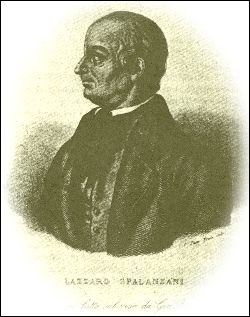
The mystery of how bats fly in complete darkness has fascinated biologists for over two centuries, at the very least. Until the middle of this century, when evidence of their sense of biological sonar became overwhelming, the mystery was called "Spallanzani's bat problem". The physiologist Lazaro Spallanzani (1729 - 1799) was a professor at various universities in Italy - at Reggio, Modena and Pavia. In his mid sixties, he turned his attention to bats. He was amazed that bats surpassed even owls in their abilities to avoid obstacles in the dark. Owls have eyes that are very sensitive to low levels of light, and can use vision to orientate at night. However, when Spallanzani exposed them to complete darkness, without moonlight or starlight, he found they were disorientated, and would collide with walls and other obstacles. In contrast, when he allowed bats to fly in complete darkness, they were not at all disorientated. Was the eyesight of bats so sensitive that they could detect and use intensities of light that humans, or even owls could not detect? Spallanzani was perplexed, but he continued to pursue the problem. |
View some of Spallanzani's original manuscript, the background of this page (from Dijkgraaf, S. 1949. Experientia 2:90-92). |
|
|
|
|