The
Discovery of Biosonar:
3. Donald Griffin |
 |
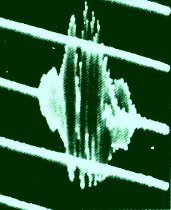
Big Brown
Bat (Eptesicus fuscus)
|
|
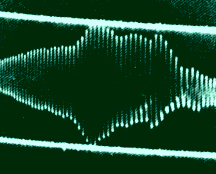
Early oscilloscope
images of the sounds produced by bats, from "Listening
in the Dark", by Donald Griffin, Cornell University
Press, 1958
Little
Brown Bat (Myotis lucifugus)
|
|
|
In 1938, a student called Donald Griffin, who worked
with bats, wanted to solve Spallanzani's Bat Problem
for good. He heard about a pioneering professor called
J.W. Pierce, who was investigating, for the first
time, sounds of frequencies beyond the human range
of hearing - ultrasounds.
Pierce had built a "sonic detector" to
detect ultrasound, perhaps the only one in the world
at that time. It consisted of a specialised microphone
and an electrical circuit that converted ultrasound
into sound that humans can hear. He used it to listen
to the ultrasound of insects.
What would happen if Griffin and Pierce used the
sonic detector on bats? They found that bats in fact
emit powerful pulses of ultrasound continuously, especially
while in flight. Later, Griffin measured the sounds
with an oscilloscope (right).
|
|
 time line
 page 3