The
Discovery of Biosonar:
3. Donald Griffin |
 |
Big Brown
Bat (Eptesicus fuscus)
|
|
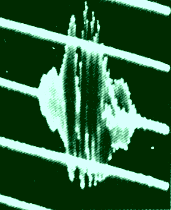
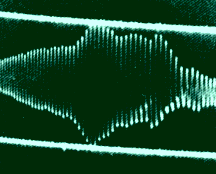
Early oscilloscope
images of the sounds produced by bats, from "Listening
in the Dark", by Donald Griffin, Cornell University
Press, 1958
Little
Brown Bat (Myotis lucifugus)
|
|
|
Were these the sounds bats used for orientation
in darkness? Griffin needed to make sure by holding
the mouths of bats shut with tape. The bats were useless
at orientation, and bumped into obstacles all the
time!
So to avoid obstacles in darkness, bats need (1)
their hearing, and (2) the ability to emit these pulses
of ultrasound. This seems like enough evidence that
bats use biosonar, doesn't it? A bat must emit these
sounds, and then wait for the echoes to return, which
would give the bat information on the distances to
obstacles.
But this wasn't enough evidence for Griffin, or
the rest of the scientific community. Griffin and
others spent the next 20 years gathering evidence
of the sonar abilities of bats. Griffin wrote about
it all, for a non-specialist audience, in his book
"Listening in the Dark" (Cornell University
Press, 1958).
|
|
 time line
 page 4