The
Discovery of Biosonar:
3. Dijkgraaf and the Ticklaut |
 |
Big Brown
Bat (Eptesicus fuscus)
|
|
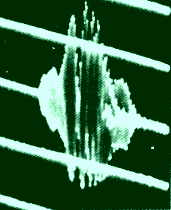
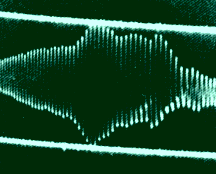
Early oscilloscope
images of the sounds produced by bats, from "Listening
in the Dark", by Donald Griffin, Cornell University
Press, 1958
Little
Brown Bat (Myotis lucifugus)
|
|
|
Meanwhile, the dutch zoologist Dijkgraaf was coming
to the same conclusions as Griffin. He worked in war
time (1939-1945), and the usual channels of scientific
communication were closed. The world got to hear about
his work in 1946.
He noticed that bats emit a very faint ticking sound
when in flight, like the ticking of a watch. He called
this the ticklaut. The bats made more ticklauts when
they neared obstacles, or performed difficult manouevres.
The ticklaut is actually what we can hear of the bat's
ultrasonic sonar sounds: because the ultrasonic sonar
sounds are produced so quickly, a tiny piece of energy
leaks down into the audible range.
It seems amazing that nobody noticed these ticklauts
before. They should have provided a clue to earlier
biologists that the bats were making sounds, possibly
outside the usual hearing range of humans. Why couldn't
Spallanzani hear them, for instance? Perhaps because
he was so old. When we get older, we lose our high-frequency
hearing. The ticklaut, although in the usual audible
range, is still very high in frequency.
|
|
 time line
 close
close